
Buying a Smart Fan in 2026? Here’s What to Look For.
A fan that's too noisy for the bedroom, a model that only cools the corner by the sofa, or a device you constantly have to adjust by hand. The search for the right fan can easily lead to a purchase you'll regret. A smart fan often solves these problems, but the specifications can be overwhelming. This article will help you understand the features and choose a model that fits your needs.
Buyer's Guide: How to Choose the Right Smart Fan
To make an informed decision, it's helpful to pay attention to several key specifications. These parameters determine how a fan performs in practice.
Noise Level (dB)
A quiet fan is essential, especially for the bedroom. The noise level is expressed in decibels (dB). A value below 30 dB is generally considered whisper-quiet and is suitable for light sleepers. Manufacturers often list the minimum noise level at the lowest setting. Pay close attention to this if silence is a priority.
Connectivity and Control
The "smart" aspect lies in the controls. Most models offer multiple options:
- Fan with an app: This allows you to control the fan from your smartphone, even when you're not home. It's convenient for pre-cooling a room before you arrive.
- Voice control: Integration with assistants like Google Home or Amazon Alexa enables operation via voice commands.
- Fan with a remote control: A physical remote remains a practical addition for quick adjustments without needing to grab your phone.
Airflow and Oscillation
A fan's effectiveness depends on its airflow, often expressed in cubic meters per hour (m³/h), and its oscillation (swiveling motion). A smart tower fan with a wide oscillation angle (e.g., 90° or more) can cool an entire room evenly. Some models even offer 3D oscillation (horizontal and vertical) for complete air circulation.
Energy Consumption
An energy-efficient fan is often equipped with a DC motor (direct current motor). These motors are quieter, consume significantly less power than traditional AC motors, and typically have a longer lifespan. The power, expressed in Watts (W), gives an indication of consumption.
Extra Features
Some smart fans offer more than just airflow. A popular combination is an air purifier and fan in one. These devices contain filters (like HEPA) to remove dust, pollen, and other particles from the air. The cleaning effectiveness is indicated by the CADR (Clean Air Delivery Rate) value.
Our Top Picks for 2026
Based on the criteria above, we have highlighted several models that address different needs.
DREO Smart Tower Fan DR-HTF013S
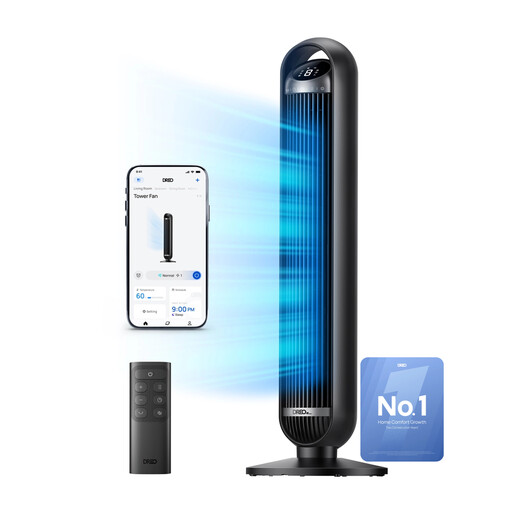
Why This Product This DREO model is a tower fan that focuses on quiet operation and smart integration. The combination of a low noise level and control via app or voice makes it a practical choice for the bedroom or living room.
Pros
- Ultra-quiet operation: Produces only 25 dB on its lowest setting, thanks to TurboSilent technology and a brushless DC motor.
- Comprehensive control: Fully controllable via the Dreo app, voice assistants (Alexa/Google Assistant), and the included remote.
- Customisable airflow: Offers 4 modes (Normal, Natural, Sleep, Auto) and 8 speeds.
- Wide coverage: The 90° oscillation ensures excellent air distribution throughout the room.
Who It's For This model is particularly suitable for light sleepers and users looking for a quiet, smart tower fan for the bedroom or a home office.
PELONIS 10" Smart WiFi Standing Fan
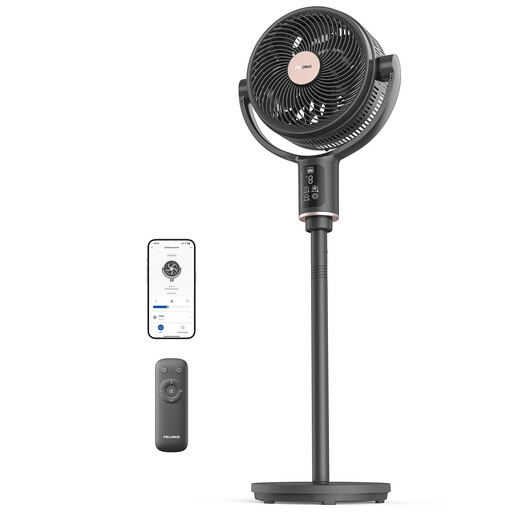
Why This Product The PELONIS fan focuses on powerful, three-dimensional air circulation. Its patented dual-blade technology is designed to move air throughout the entire room, rather than just blowing in one direction.
Pros
- 3D air circulation: Combines horizontal and vertical oscillation for a 360° vortex effect, which helps to distribute the temperature evenly across the room.
- Quiet DC motor: Operates at a noise level starting from 26 dB and is energy-efficient with a consumption of 32W.
- Flexible design: The height is adjustable from 36 cm to 110 cm without tools, allowing it to be used as a table or standing fan.
- Smart control: Integrates with Alexa and can be operated via an app or the included remote control.
Who It's For Users with larger living rooms or spaces with uneven temperatures will benefit from this model's powerful circulation technology. Its adjustable height makes it a versatile choice.
Monsga 2-in-1 Smart Air Purifier & Circulator Fan AP200
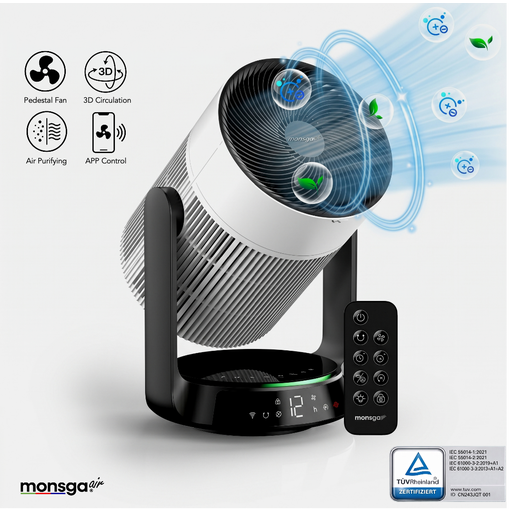
Why This Product This device from Monsga is an air purifier and fan in one. It is designed for year-round use: cooling in the summer, circulating warm air in the winter, and purifying the air throughout the year.
Pros
- Integrated air purifier: Features a filter with a CADR of 280 m³/h, effective against allergens, dust, and PM2.5 particles.
- Omnidirectional oscillation: A unique 360° rotating base combined with 90° horizontal and 120° vertical movement ensures complete air exchange throughout the room.
- Quiet operation: The sleep mode produces a noise level of just 25 dB.
- Energy-saving: Can be placed next to an air conditioner or heater to distribute cooled or heated air more quickly, which can help reduce energy costs.
Who It's For This 2-in-1 model is an excellent choice for people with allergies, families with children, or anyone who values a healthy indoor climate. It is ideal for use in poorly ventilated spaces.
Didn't Find a Match? Explore More Options
The products above are examples of what's available in the world of smart fans. Every situation calls for a different solution. Are you looking for a different type of model, a specific power rating, or a different price range?
Check out our full range of cooling fans for more models and specifications.
Frequently Asked Questions About Smart Fans
What is the advantage of a fan with a DC motor? A fan with a DC motor (direct current) is typically significantly more energy-efficient and quieter than a model with a traditional AC motor (alternating current). They also often offer more speed settings, providing more precise control over the airflow.
Can a smart fan really help with allergies? A standard fan only moves air, including dust and allergens. However, a model that functions as an air purifier and fan in one can help. These devices use filters (like HEPA) to capture particles from the air. Pay attention to the CADR (Clean Air Delivery Rate) to assess the effectiveness of the air purification.
Does a smart fan work well with an air conditioner? Yes, a smart fan can improve the efficiency of an air conditioner. By strategically placing the fan, the cool air produced by the AC is distributed more quickly and evenly throughout the room. This helps the room cool down faster and may allow the AC to be set to a lower setting, saving energy.