
Remote Control Sockets: Our Top Recommendations
Is that one floor lamp also tucked away behind your sofa, forcing you to reach into an awkward corner every evening to turn it on? Or do you dread the day you have to bring out all the Christmas lights and switch each cord on and off individually? You're not alone. Many people are looking for a simple, hassle-free way to control their devices.
A remote control socket is often the most straightforward solution. It offers convenience, helps save energy by eliminating standby power, and makes your home more accessible. In this article, as your Joybuy Product Recommendation Officer, I will provide objective and practical advice to help you make your choice. No marketing jargon, just clear information.
What to Look for When Buying
Before you make a choice, there are a few specifications that make all the difference. By paying attention to these, you can be sure to select a product that fits your needs.
1. Control Type: Radio Frequency or Wi-Fi?
Most remote control sockets fall into two categories:
- Radio Frequency (RF) Socket: This type works with a simple, physical remote control. Its main advantage is simplicity: plug it in, and it works instantly. The signal is often strong enough to pass through walls and furniture. Ideal if you don't want to use a smartphone app and just need a remote on/off button.
- Smart Plug (Wi-Fi): These plugs connect to your Wi-Fi network and are controlled via an app on your phone. This opens up extra features, such as setting schedules, remote control when you're away from home, and sometimes even voice control via assistants like Google Home or Alexa. Some models also function as an energy-saving plug by measuring power consumption.
2. Maximum Power (Watts) and Current (Amps)
Not every switched plug is suitable for every appliance. The maximum power capacity, expressed in Watts (W) and Amps (A), is crucial for safety.
- For lighting, chargers, or a radio, a standard plug is usually sufficient.
- For high-consumption appliances like an electric heater, kettle, or a heavy-duty pump, you need a model that can handle a higher power load. A plug rated at 16A and 3680W is a robust choice suitable for most household appliances. Always check the power rating of the device you intend to connect.
3. Range and Expandability
The remote's range is especially important for an RF socket. A typical range is around 30 metres in open space. In a house with walls and doors, this will be slightly less. Consider from what distance you'll need to operate the socket. Additionally, some sets are expandable, meaning you can add more sockets later and control them with the same remote.
Recommended Products
Based on functionality and ease of use, we have highlighted a few popular choices for you.
Dewenwils Wireless Socket with Removable Wall Switch
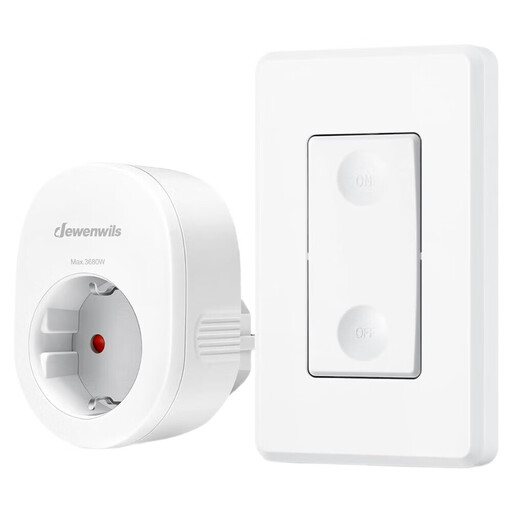
Why it stands out: This product combines the simplicity of a wireless socket with the convenience of a fixed wall switch, without any drilling or wiring required. The switch can be mounted on the wall, and the remote control can be detached from it. This gives you the flexibility of a portable remote and a fixed switch location.
Pros:
- Flexible Installation: The wall switch can be placed anywhere without destructive work.
- Ready to Use Out of the Box: The transmitter and receiver are pre-programmed.
- Long Range: According to the manufacturer, the RF signal has a range of up to 30 metres in open space and works well through walls.
- High Power Capacity: Suitable for appliances up to 16A / 3680W.
Who is this for? Ideal for anyone who wants to add an extra light switch to an existing lamp—for instance, next to the bed or at a room's entrance—without a complicated installation.
Antela Wi-Fi Smart Socket with Energy Monitoring (2-pack)
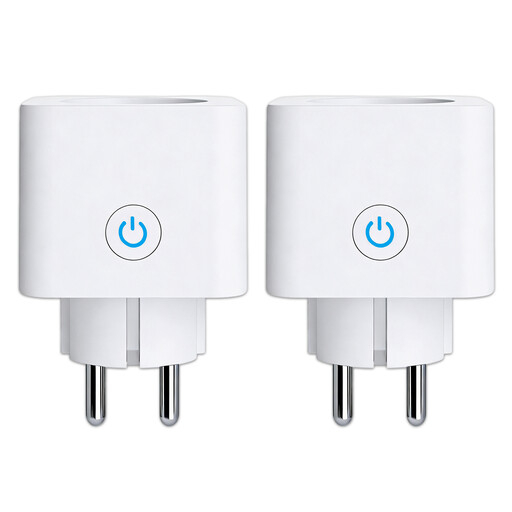
Why it stands out: This is a true smart plug for the user who wants more than just on/off control. Through the app, you can set schedules, monitor power consumption, and control the plug with your voice. The energy monitoring feature makes it an excellent energy-saving plug for identifying devices that draw phantom power.
Pros:
- Energy Monitoring: Provides insight into the power consumption of connected devices.
- App and Voice Control: Works with an app and, according to the manufacturer, is compatible with Alexa and Google Home.
- Schedules and Timers: Automate when your devices turn on or off.
- Powerful: Supports a load of up to 16A / 3680W.
Who is this for? Perfect for the tech enthusiast, for people who want to automate their home, and for anyone who wants to manage energy consciously and gain insight into their consumption.
DEWENWILS Radio Frequency Socket Set
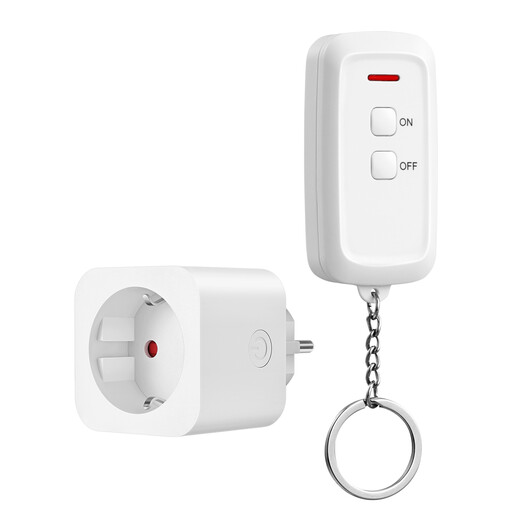
Why it stands out: This set is the definition of simplicity. No apps, no Wi-Fi, no setup. You plug the socket into the wall, connect your appliance, and control it with the included remote. This is the classic plug with a remote on/off switch that works right out of the box.
Pros:
- Plug & Play: No configuration needed, ready to use immediately.
- Compact Size: The design is slim and unobtrusive in most interiors.
- Strong Signal: The 433.92 MHz frequency ensures a reliable connection, even through doors and walls.
- Energy-Efficient: After a power outage, the socket remains off to save energy. According to the manufacturer, its standby consumption is only 0.6W.
Who is this for? Extremely suitable for seniors, people with limited mobility, or anyone looking for a reliable and incredibly simple solution. It's also a popular choice as a socket for Christmas lights and other seasonal decorations.
Haven't Found What You're Looking For?
The world of wireless control is vast. If the options above aren't exactly what you had in mind, or if you're looking for sets with more sockets or different features, there's plenty more to discover.
Explore more remote control sockets
Frequently Asked Questions
1. How do you install a remote control socket? For most RF models, there is no installation. You plug the receiver (the socket) into the wall outlet and plug the device you want to control into the receiver. The remote is often already paired and works immediately. For a smart plug (Wi-Fi), you follow the instructions in the companion app to connect the plug to your network.
2. Does a wireless socket consume power itself? Yes, a wireless socket consumes a very small amount of power in standby mode to receive the signal from the remote. This is known as phantom load or standby power. On modern models, this consumption is minimal, often less than 1 Watt. This is easily offset by the savings you achieve by completely turning off appliances instead of leaving them on standby.
3. Do these plugs also work for outdoor lighting, like Christmas lights? Yes, this is a very popular application. However, be sure to choose a model specifically designed for outdoor use. Outdoor models have a higher IP rating (e.g., IP44), which means they are protected against weather elements like rain. The models mentioned above are intended for indoor use.