
Buying a QIDI 3D Printer: A Guide to Professional Results
Are you looking for a 3D printer that goes beyond the basics? A machine that combines speed, precision, and the ability to work with advanced materials? Then you have likely already come across the name QIDI. For serious hobbyists, SMEs, and educational institutions, choosing the right professional 3D printer can be a challenge. The specifications are often complex, and it's difficult to determine which features will truly make a difference for your projects.
As a Joybuy Product Recommendation Officer, my job is to help you make an informed choice. In this article, we will take a closer look at QIDI 3D printers and provide practical tips so you can find the printer that matches your ambitions.
What to Look for When Buying a 3D Printer
Before we look at specific models, here are a few key considerations to help you make the right choice.
1. The Importance of an Enclosed and Heated Print Chamber
An enclosed 3D printer with an actively heated chamber is crucial for working with engineering materials like ABS, ASA, PC, and nylon. A constant, high ambient temperature (65°C is a good guideline) prevents the model from cooling unevenly. This minimises warping and ensures better layer adhesion. This is especially important for large objects or functional parts where dimensional accuracy is essential.
2. Speed and Stability
A high-speed 3D printer is appealing, but speed should not come at the expense of quality. Modern printers use techniques like input shaping and pressure advance to compensate for vibrations at high speeds. Also, pay attention to the printer's construction. A robust metal frame and high-quality guides (like linear rails) are indicators of a machine built for stable performance, even at speeds of 600 mm/s or more.
3. Material Choice and Versatility
Think about the materials you want to use. For printing with abrasive filaments, such as with a carbon fiber 3D printer or glass-fiber-reinforced nylon, a hardened steel nozzle is a requirement. A standard brass nozzle would wear out very quickly. A printer with a high-flow hotend that can reach high temperatures (above 300°C) offers the most flexibility for future projects. The ability to expand later, for example with a multi-color 3D printer system, can also be a decisive factor.
Top QIDI 3D Printer Picks
Based on specifications and functionality, we have made a selection of QIDI models that excel in various applications.
QIDIxJOYBUY Q2: The Versatile Powerhouse
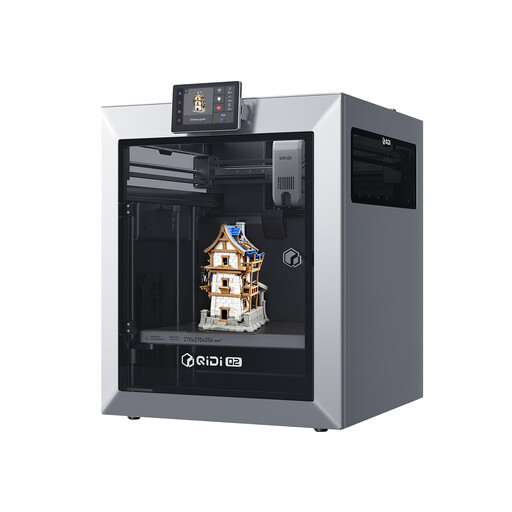
Why It Stands Out The QIDI Q2 is an impressive all-rounder that makes professional features accessible. According to the manufacturer, the printer is ready for its first print within 15 minutes of unboxing. The machine features fully automatic calibration, where the nozzle itself acts as a sensor for a precise first layer. The combination of an actively heated chamber up to 65°C, an all-metal hotend that can reach 370°C, and a print speed of up to 600 mm/s makes it suitable for a wide range of materials and projects.
Key Features
- Enclosed and Heated Chamber (65°C): Ideal for engineering filaments and consistent results.
- High Print Speed: Up to 600 mm/s with an acceleration of 20,000 mm/s?.
- Advanced Features: AI camera for error detection, filament sensor, and power loss recovery.
- Air Filtration: A 3-in-1 filter system (pre-filter, HEPA H12, activated carbon) makes it safer for indoor use.
- Expandable: Compatible with the optional QIDI BOX for 16-colour printing.
Who Is It For? The Q2 is an excellent choice for makers, educational institutions, and small businesses looking for a reliable and versatile printer that grows with their skills. It bridges the gap between ease of use and professional capabilities.
QIDIxJOYBUY Max4: For Large-Scale Projects
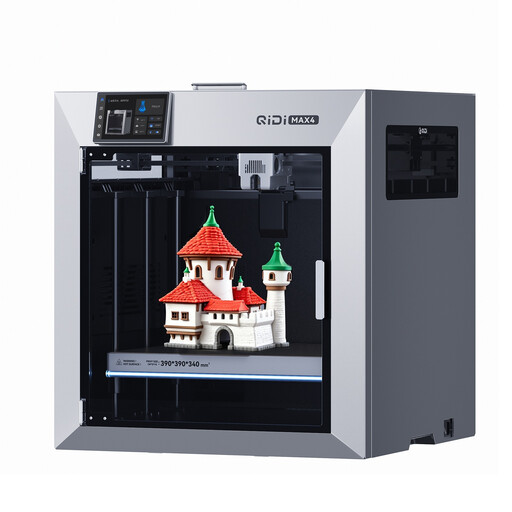
Why It Stands Out When size matters, the QIDI Max4 offers the solution. With a massive build volume of 390×390×340 mm, this is a large-format 3D printer designed for industrial applications, large prototypes, or producing multiple parts at once. The Max4 combines this volume with an even higher speed of up to 800 mm/s. The closed-loop motors on the X/Y axes provide extra precision and prevent step loss during printing.
Key Features
- Massive Build Volume: 55% larger than its predecessor, ideal for large objects.
- Very High Speed: Print speeds up to 800 mm/s with an acceleration of 30,000 mm/s?.
- Industrial Precision: Closed-loop motors and a precision Z-axis for smooth and accurate prints.
- Actively Heated Chamber (65°C): Enables printing of large models with materials like ABS-CF and PPS-CF without warping.
- Smart Monitoring: The AI camera detects print failures and automatically pauses the print.
Who Is It For? The Max4 is aimed at professionals, engineers, and SMEs who need to produce functional parts, moulds, or large-scale prototypes. It is a machine for those who do not want to compromise on size and performance.
QIDIxJOYBUY Max4 Combo: Large Format and Multi-Material
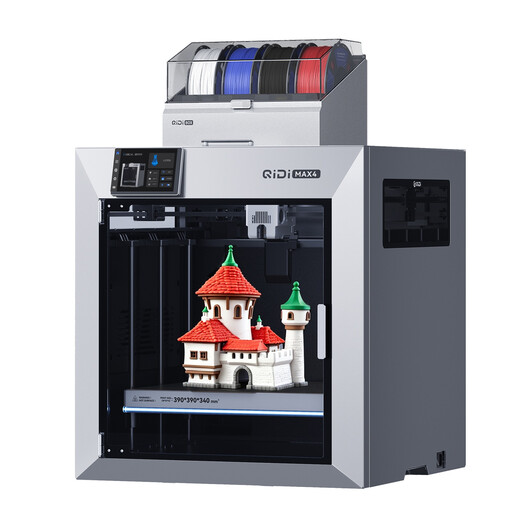
Why It Stands Out The Max4 Combo is the ultimate bundle for those who want to get started with complex, multi-colour projects right away. This package includes the QIDI Max4 printer and the QIDI BOX. This box allows you to work with up to 16 different colours or materials in a single print job. The QIDI BOX manages the filaments, keeps them dry, and automatically switches materials. This opens the door to highly complex visual prototypes and functional parts with different material properties.
Key Features
- All the benefits of the Max4: Including the large build volume, high speed, and heated chamber.
- Instant Multi-Material/Multi-Colour: The included QIDI BOX enables printing with up to 16 filaments.
- Smart Filament Management: The box ensures smooth switching and keeps materials in good condition.
- Complete Solution: An integrated system for the most demanding print jobs.
Who Is It For? This combo is the choice for design agencies, R&D departments, and product developers who want to push the boundaries of FDM 3D printing. If you have an immediate need for a multi-color 3D-printer with a large build volume, this is the most complete solution.
Still Looking for Other Options?
QIDI printers offer a strong combination of speed, precision, and material compatibility. However, if you are looking for different specifications or models, you can explore our broader range.
See more options in our Technology Desk category.
Frequently Asked Questions (FAQ)
1. Can a QIDI printer print carbon fiber?
Yes, models like the Q2 and Max4 are very suitable as a carbon fiber 3D printer and for other abrasive composites. They are equipped with a hardened steel nozzle and a high-flow hotend that can handle the high temperatures. The enclosed and heated chamber also provides the necessary environmental stability to prevent warping with these materials.
2. What is the main difference between the QIDI Q2 and the Max4?
The main difference lies in the build volume and maximum print speed. The QIDI Max4 has a significantly larger print area (390x390x340 mm vs. 270x270x256 mm for the Q2) and a higher top speed (800 mm/s vs. 600 mm/s). The Q2 is a very capable all-rounder, while the Max4 is designed for users who specifically need a large-format 3D printer for industrial or large-scale applications.
3. Is a QIDI 3D printer suitable for beginners?
Although QIDI printers offer professional features, they are designed with ease of use in mind. Features like fully automatic calibration, an intuitive touchscreen, and quick setup make them accessible. However, they are primarily aimed at users who expect serious results and are willing to learn to work with more advanced materials and settings. They provide an excellent platform to grow into.