
Multi-Color 3D Printers: Our 2026 Recommendations
Choosing an advanced 3D printer is a significant investment. The wrong choice can quickly lead to frustration: failed prints, incompatible materials, or a machine that doesn't deliver on its promised speed and precision. It's essential to select a model that aligns with your technical requirements, especially when producing complex, multi-color, or functional parts. This article provides a practical guide to the key selection criteria and presents several models designed for these specific tasks.
What to Look For in a Multi-Material 3D Printer?
Before making a choice, it's important to understand the specifications that distinguish a standard FDM printer from a professional 3D printer suitable for complex projects.
Multi-Color & Multi-Material System (AMS)
A printer with multi-color capability can work with multiple filaments simultaneously. The most advanced systems, often called an AMS (Automatic Material System), do more than just switch colors. They offer features like automatic filament type detection (via RFID), seamlessly switching to a new spool when the old one runs out (auto-refill), and detecting tangled filament. This is crucial for long, unattended prints.
Speed and Structure (CoreXY)
For prints that are both fast and precise, the printer's mechanical structure is a key factor. Many high-end models use a CoreXY 3D printer design. In this system, the heavy stepper motors remain stationary, allowing the print head to move with much lower mass. This results in higher print speeds (up to 600 mm/s) and accelerations (20,000 mm/s² or more) with fewer vibrations and better print quality.
Material Compatibility and Temperature Management
The ability to print with engineering-grade materials like ABS, ASA, PC, or carbon fibre composites (a 3D printer for carbon fibre) depends directly on temperature control. Three components are essential for this:
- High-temperature nozzle: A nozzle that can reach temperatures of 300°C or higher is necessary for engineering-grade filaments.
- Enclosed frame: An enclosed 3D printer minimises temperature fluctuations and protects the print from drafts, which is crucial for preventing warping.
- Heated chamber: A 3D printer with a heated chamber takes it a step further. By actively heating the entire chamber (e.g., to 65°C), internal stress in the material is drastically reduced, leading to stronger parts with superior layer adhesion.
Build Volume and Ease of Use
The build volume determines the maximum size of your prints. Think carefully about the size of the objects you want to produce. Additionally, features like fully automatic bed levelling, AI cameras for error detection, and an intuitive touchscreen make the printing process significantly easier and more reliable.
Our Selection: Popular Multi-Color 3D Printers in 2026
Based on the criteria above, we have selected printers that excel in multi-color and multi-material performance.
Elegoo Centauri Carbon 2 Combo
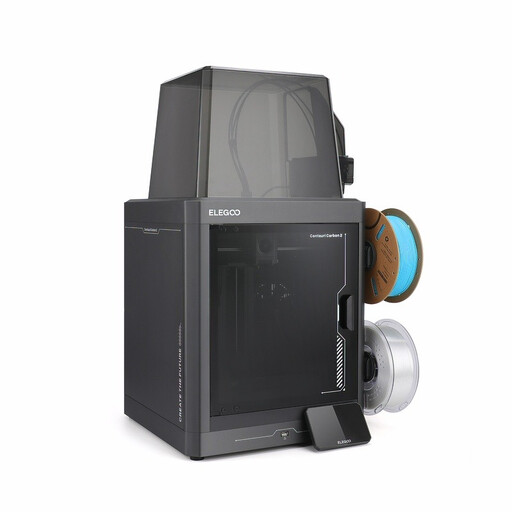
Why This Product The Elegoo Centauri Carbon 2 Combo is designed as an accessible all-in-one solution. It integrates a 4-color system (CANVAS) directly into a quiet, enclosed frame. The focus is on a seamless user experience, from automatic calibration to printing with engineering materials, without the complexity often associated with professional machines.
Advantages
- Integrated 4-color system: The CANVAS system provides automatic color changes, RFID filament detection, and tangled filament detection.
- High speed and precision: Thanks to its CoreXY structure and a lightweight print head, the printer achieves speeds up to 500 mm/s.
- Material Versatility: The hardened steel nozzle can heat up to 350°C, suitable for PLA, PETG, ASA, and carbon fibre composites.
- Smart Temperature Control: An automated grille regulates airflow in the chamber, which helps prevent warping with materials like ABS.
- Quiet Operation: With a noise level of around 45 dB, the printer is suitable for use in an office or home environment.
Who It's For For prosumers, designers, and small businesses seeking a reliable and user-friendly multi-color 3D printer for both aesthetic models and functional prototypes.
QIDI Q2 Combo 3D Printer
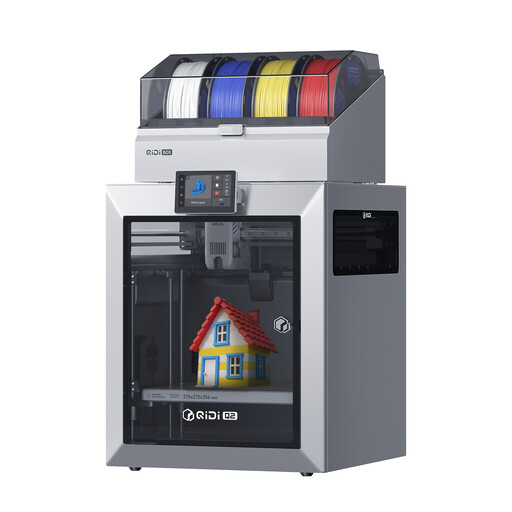
Why This Product The QIDI Q2 Combo stands out with its actively heated chamber, which can maintain a constant temperature of 65°C. This makes it an exceptionally capable machine for printing demanding engineering materials prone to shrinkage and warping, such as PC and nylon. The accompanying QIDI BOX enables printing with up to 16 colors and keeps filaments dry during printing.
Advantages
- Actively heated chamber (65°C): Minimises warping and ensures superior layer adhesion for engineering-grade filaments.
- High-temperature nozzle: The nozzle can be heated up to 370°C, opening the door to a wide range of high-performance materials.
- High print speed: A stable CoreXY structure enables print speeds up to 600 mm/s.
- Multi-material with drying function: The QIDI BOX supports up to 16 colors/materials and includes a drying system to ensure filament quality.
- Precise Calibration: The nozzle itself acts as the sensor for bed levelling, which, according to the manufacturer, ensures a highly reliable first layer.
Who It's For For engineers and manufacturers who need to create functional parts and prototypes from materials like ABS, PC, PA-CF, and other composites, where dimensional accuracy and mechanical strength are crucial.
Creality K2 Plus Combo 3D Printer
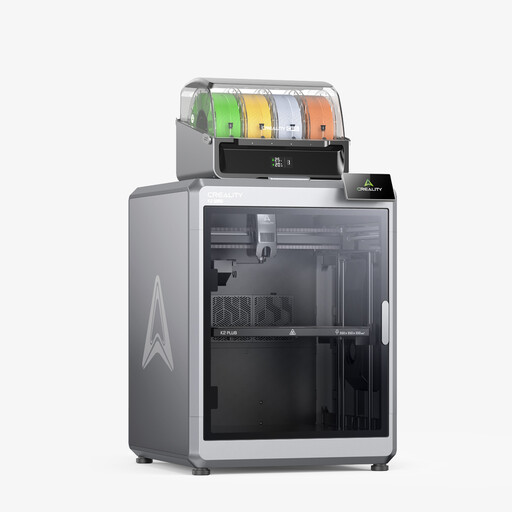
Why This Product The Creality K2 Plus Combo addresses a common bottleneck: build volume. With a generous print area of 350 x 350 x 350 mm, this printer is ideal for producing large objects or printing multiple parts in a single batch. This is combined with Creality's CFS (Color Filament System) for 16-color prints and high print speeds.
Advantages
- Large build volume: The 350 x 350 x 350 mm volume offers significantly more space than most competitors in its class.
- 16-color printing: The CFS system enables complex, multi-color models.
- High speed and acceleration: Print speeds up to 600 mm/s and acceleration up to 30,000 mm/s² thanks to the CoreXY structure.
- Excellent Temperature Control: With a nozzle up to 350°C, a print bed up to 120°C, and a heated chamber up to 60°C, the printer is suitable for a wide range of filaments.
- Dual AI Cameras: For remote live monitoring and intelligent detection of print issues.
Who It's For For users who regularly need to print large models, full-scale functional prototypes, or production batches and don't want to compromise on the benefits of a fast 3D printer with multi-color functionality.
Haven't Found What You're Looking For?
The models listed above are specifically designed as complete multi-color systems. If you are looking for a model with different specifications, or if you want to start with an entry-level printer that you can upgrade later, a wide range of options is available.
Check out our full selection and compare different models based on your specific needs in the FDM printer category.
Frequently Asked Questions
What is the difference between a multi-color and a multi-material 3D printer? Technically, there is little difference. A system that can feed multiple filaments can combine different colors of the same material (multi-color) as well as completely different materials (multi-material) in a single print. Think of combining rigid PLA with flexible TPU. The main prerequisite is that the materials have compatible printing temperatures.
Is an enclosed frame necessary for multi-color printing? For materials like PLA or PETG, an enclosed frame is not strictly necessary. However, most advanced multi-color printers are designed for professional use and come with an enclosed frame as standard. This is essential for printing with engineering materials like ABS, ASA, or nylon, as it helps keep the temperature stable and prevents warping.
What is a CoreXY 3D printer and why is it faster? A CoreXY is a mechanical system where the print head is moved along the X and Y axes by two stationary motors working together via a belt system. Because the motors do not move with the print head, the moving mass is much lower. This allows the print head to accelerate and change direction faster with fewer vibrations, resulting in higher print speeds without sacrificing quality.
Written by: Joybuy Product Recommendation Officer