
Choosing the Right H4 LED Headlight in 2026: A Practical Guide
Upgrading to H4 LED headlights seems like a logical step for better visibility and a more modern look for your car. However, the reality can be more challenging. A common issue is purchasing bulbs that don't fit, trigger a dashboard error message, or, worse, blind oncoming drivers with an improper beam pattern. This article provides a practical guide to making the right choice, based on product specifications and functionality.
Buying Guide: What to Look for in an H4 LED Headlight Replacement
To avoid a bad purchase, it's helpful to understand a few technical parameters. These specifications determine the performance, compatibility, and lifespan of your new lighting.
1. Light Output (Lumen) and Beam Pattern
The light output, expressed in lumens (LM), indicates the total amount of visible light a bulb produces. In theory, more lumens mean a brighter bulb. However, its effectiveness depends on the beam pattern. An H4 LED bulb has a dual function: H4 low beam and H4 high beam. A well-designed bulb accurately mimics the light pattern of the original halogen bulb. This ensures a sharp cut-off line on low beam, illuminating the road effectively without hindering oncoming drivers.
2. Colour Temperature (Kelvin)
The colour temperature, measured in Kelvin (K), determines the colour of the light. Standard halogen bulbs have a yellowish glow of around 3200K. Most H4 LED bulbs have a colour temperature of around 6000K, resulting in a bright, cool white light. This is often perceived as more modern and comfortable during night-time driving, as it makes contrasts on the road more visible.
3. Ease of Installation (Plug and Play)
For the DIY enthusiast, ease of installation is a key factor. Look for plug-and-play headlights with a "1:1 mini design". This means the LED bulb is identical in size and connection to the original halogen bulb. As a result, they fit directly into the existing housing without modifications, extra cables, or external drivers.
4. Compatibility (CAN bus)
Modern cars use a CAN bus (Controller Area Network) system to monitor the status of various components, including the headlights. Because LED bulbs consume less power than halogen bulbs, the CAN bus system might interpret this as a faulty bulb and display an error message on the dashboard. A CAN bus H4 LED bulb has a built-in resistor or circuitry to prevent this. For 99% of vehicles, a "CAN bus ready" bulb is sufficient. For a few sensitive models, an external decoder may still be necessary.
5. Cooling and Lifespan
LED chips produce heat. An effective cooling system is crucial for performance and lifespan. There are two main types:
- Passive cooling (fanless): Uses a heat sink, for example, made of aviation-grade aluminium, to dissipate heat. The advantage is that there are no moving parts that can wear out or make noise.
- Active cooling (with a fan): Uses a small, high-speed fan to actively dissipate heat. This can allow for a more compact design and higher performance.
Our Recommendations for H4 LED Bulbs in 2026
Based on the criteria above, we have selected two products that offer different features and benefits.
1. KATUR H4 LED Headlight Bulbs, 26000LM 80W
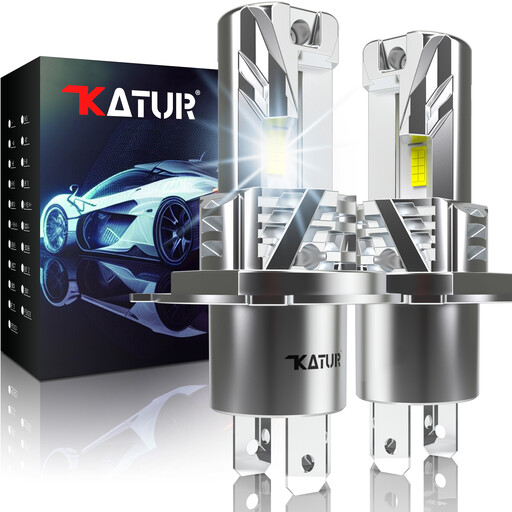
Why this product? This set from KATUR stands out due to its high stated light output of 26,000 lumens per pair and its fanless design. The passive cooling via the 6063 aviation-grade aluminium heat sink ensures silent operation with no moving parts that can fail. The 1:1 mini-design makes it a true plug-and-play solution.
Pros:
- High light output: With 80W and 26,000LM per pair, these bulbs provide a significant amount of light.
- Silent operation: The fanless design eliminates the noise of a cooling fan.
- Easy installation: The compact, all-in-one design fits directly into the original housing without external drivers.
Who is this for? For the driver seeking maximum light output who prefers a completely silent, maintenance-free solution. The simple installation makes it a great choice for DIY enthusiasts who want to upgrade quickly and without modifications.
2. EndureLite H4 LED Bulbs, 20000LM
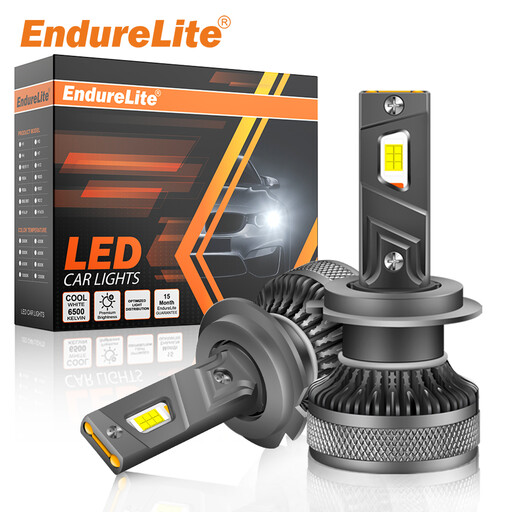
Why this product? The EndureLite H4 bulbs focus on precisely replicating the halogen format (1:1 mini design) and durability. According to the manufacturer, they are 300% brighter than halogen. The active cooling, featuring a 12,000 RPM fan, ensures a stable temperature, contributing to the claimed 50,000-hour lifespan. The IP68 waterproof rating makes them suitable for use in all weather conditions.
Pros:
- Precise fit: The 1:1 design guarantees a seamless installation in most vehicles.
- Active cooling: The fan provides efficient heat dissipation, which can extend the lifespan.
- Waterproof (IP68): Offers reliability in rain, fog, and other wet conditions.
Who is this for? For the user who prioritises the easiest possible installation and a long lifespan. The active cooling and IP68 rating make it a robust choice for drivers who operate in variable weather conditions.
Alternative Preparations
Good preparation doesn't stop with your car. Whether you're caught in an unexpected downpour during an outdoor project or preparing for a camping trip, the right gear is just as important as the right parts for your vehicle. For those looking for functional apparel for unpredictable weather, taking a look at our selection of waterproof shorts could be a smart next step.
Frequently Asked Questions (FAQ)
1. Are H4 LED bulbs road legal? Legislation regarding LED headlight replacement is specific. A headlight unit as a whole (bulb, reflector, lens) must have an E-mark approval. Aftermarket LED bulbs installed in a unit designed for halogen often lack this. Although they may technically produce a correct beam pattern, it is essential to check local regulations (such as ECE guidelines) for vehicle inspections and legality on public roads. A correctly adjusted beam pattern is the most important factor in preventing glare.
2. What is the difference between H4, 9003, and HB2? Functionally, H4, 9003, and HB2 are the same bulb. They are different designations for a dual-filament bulb that combines both low beam and high beam in a single unit. The terms are often used interchangeably, depending on the region or manufacturer. So, if you need an H4 bulb, you can also use one designated as 9003 or HB2.
3. Do I need a CAN bus decoder for my H4 LED bulbs? Most modern CAN bus H4 LED bulbs are "CAN bus ready" and work in 99% of vehicles without issues. However, some cars, particularly from European brands like Volkswagen, Audi, BMW, and Mercedes, can have extra-sensitive systems. If you notice flickering or a dashboard error message after installation, you will likely need an additional external CAN bus decoder (resistor) to resolve the problem.
Written by: Joybuy Product Recommendation Officer