
Choosing the Right Cooker Hood: A No-Nonsense Buying Guide
Choosing a new cooker hood seems simple until you start comparing specifications. Manufacturers promise the world with high extraction rates and whisper-quiet motors, but the reality is often different. Many people fall into the same traps, ending up with a noisy appliance that barely handles cooking odours. Before you make a decision, it's crucial to know what to look for.
We often see buyers disappointed by two specific deceptions:
- The Myth of High Extraction Rates: The extraction rate figure (in m?/h) on the packaging is often the 'free-blowing' value, measured without the resistance of ducting or filters. In a real kitchen, the effective capacity can be up to 30-40% lower. A model that looks powerful on paper might struggle with a simple pot of pasta in practice.
- The "Quiet" Hood That Isn't: The noise level (dB) is typically advertised at the lowest, least effective setting. As soon as you turn the hood up to a speed that actually clears cooking fumes, the noise can escalate to the level of a busy conversation or even a vacuum cleaner. A truly quiet cooker hood performs well without forcing you to turn up the TV.
Core Specifications That Really Matter
To avoid a bad purchase, it's best to focus on a few objective specifications. These determine the actual performance in your kitchen.
1. Extraction Rate: What Do You Need?
The required capacity depends on the size of your kitchen. A simple rule of thumb can help you get started:
Formula:(Length x Width x Height of the kitchen in metres) x 10 = Minimum required capacity in m?/h.
For an open-plan kitchen or if you often cook intensively (e.g., stir-frying or grilling), it's wise to choose a model with a higher capacity than this minimum. Pay attention to the capacity at a normal, everyday setting, not just the maximum 'boost' function.
2. Extraction Type: Ducting or Recirculation?
You have two choices, each with its own pros and cons.
- Ducting (Extraction): This system vents cooking fumes and moisture directly outside through a pipe. It is the most effective method for getting rid of cooking odours and humidity. This is only possible if you have or can create an opening in an external wall or roof.
- Recirculation (
ductless cooker hood): If venting to the outside isn't an option, a recirculating cooker hood is the solution. It draws in air, filters it through a grease filter and a carbon filter (to neutralise odours), and blows the clean air back into the kitchen. The downside is that moisture remains in the room, and you must periodically replace the carbon filters, which incurs extra costs.
3. Style and Dimensions: What Fits Your Kitchen?
The most common styles are the chimney hood (mounted on the wall) and the integrated hood (built into a kitchen cabinet). For a seamless look, an integrated model is ideal. A chimney hood, on the other hand, can be a design statement, for example, a modern black cooker hood.
The width of the cooker hood should be at least equal to the width of your hob, but preferably slightly wider for better fume capture. A 60 cm cooker hood is standard for most hobs, while a 90 cm cooker hood is a better fit for wider cooking zones.
Recommendations Based on Use Case
We have selected a few models that suit different UK kitchens and preferences, based on their specifications.
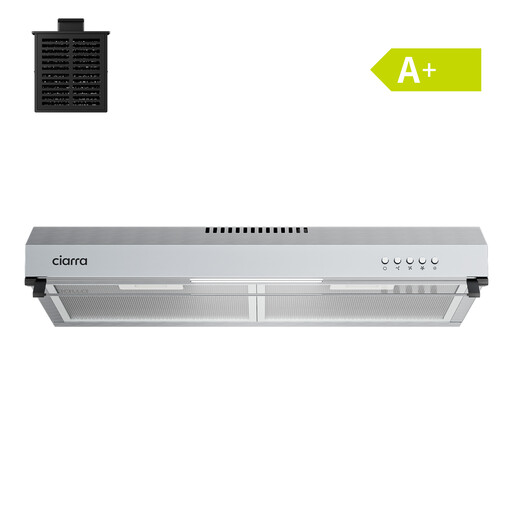
Ciarra 60cm Integrated Cooker Hood, Built-in Design
Why This Fits Their Persona: Perfect for apartments or smaller kitchens where space and a clean finish are key. This built-in model is seamlessly integrated into an upper cabinet and, at 60 cm, is suitable for standard hobs. The option for recirculation makes it ideal for homes without an external vent.
The specifications are realistic for its size. With a maximum airflow of 184 m?/h, it's not designed for a professional kitchen but is functional for daily cooking in a small space without making false promises.
Flexible installation: Suitable for both ducted and recirculating setups. Energy efficient: It has an A+ energy label, resulting in low annual consumption.
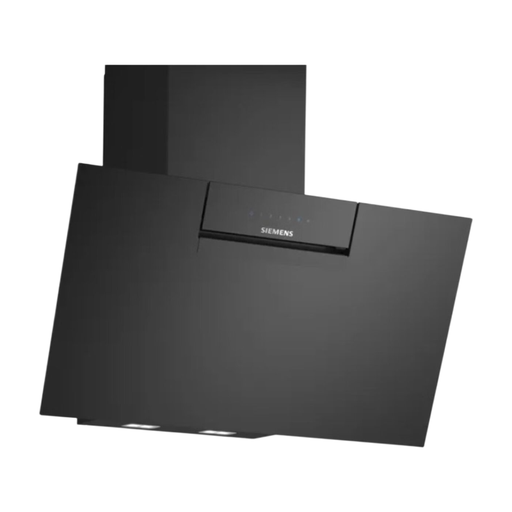
Siemens LC87KFN60 Chimney Cooker Hood
Why This Fits Their Persona: For those renovating their kitchen and seeking an appliance that is an upgrade in both performance and aesthetics. This model from Siemens is an angled chimney hood in a stylish black finish, adding a modern accent. The touch controls and dimmable lighting contribute to its premium feel.
This model combines a high capacity (763 m?/h) with an acceptable maximum noise level of 56 dB. It avoids the pitfall of a noisy motor by offering a good balance between power and comfort.
Powerful performance: The high extraction rate is suitable for medium to large kitchens. Energy efficient: With an A+ energy label, it's an efficient choice.
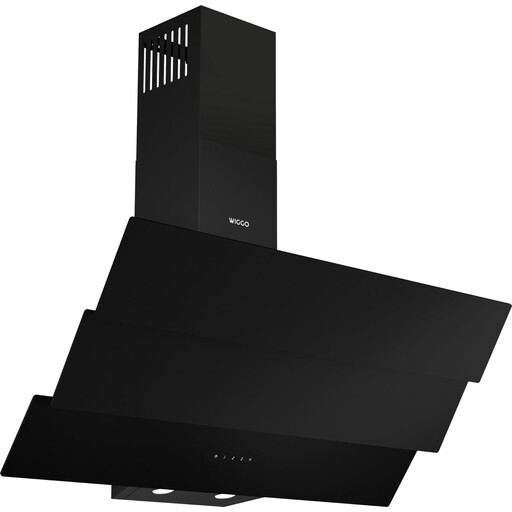
Wiggo WE-A943G(B) Chimney Cooker Hood 90 cm
Why This Fits Their Persona: In an open-plan kitchen where cooking, dining, and living converge, high capacity and an acceptable noise level are crucial. This 90 cm wide model, with 615 m?/h, offers enough power to effectively remove cooking fumes before they spread through the living area.
This model delivers high capacity without the premium price tag. The maximum noise level of 66 dB is noticeable, but the turbo mode is intended for short, intensive use. At lower settings, it offers a good balance for daily use.
High capacity: The 615 m?/h rate is very suitable for larger, open spaces. Wide coverage: The 90 cm width ensures effective fume capture over a standard or wide hob.
Looking for More Options?
We've compiled a complete, up-to-date list of products that meet these objective selection criteria and UK/EU safety regulations.
Frequently Asked Questions
How often should I clean or replace my cooker hood filters?
- Grease filters (metal): These should be cleaned about once a month, depending on how intensively you cook. Most metal filters are dishwasher-safe. A saturated grease filter reduces extraction power and increases the fire hazard.
- Carbon filters (for recirculation): These filters cannot be cleaned and must be replaced every 3 to 6 months. A saturated carbon filter can no longer absorb odours, which severely reduces the effectiveness of your recirculating hood.
Is a recirculating hood really less effective than a ducted one?
Effectiveness depends on your priority. For removing odours, a recirculating cooker hood with a good carbon filter can be very effective. For removing moisture, a ducted system that vents outside is always superior. In a well-ventilated, modern home, recirculation can be a great solution, but in older or more humid houses, ducting is often a better choice to prevent mould growth.
What is the ideal width for my cooker hood?
The rule is simple: the cooker hood should be at least as wide as your hob. A 60 cm cooker hood is standard for a 60 cm hob. If you have a wider hob of 70-80 cm, or a kitchen island, a 90 cm cooker hood is a better choice. A wider hood captures rising fumes more efficiently, especially at the sides.