
Choosing the Right Air Circulator in 2026: A Practical Guide
A standard fan that grows noisy after a few weeks and only moves the air directly in front of it is a common pitfall. An air circulator, also known as a circulation fan, takes a different approach. Instead of a direct jet of air, this device creates a current that circulates throughout the entire room. This results in an even temperature and a more pleasant atmosphere, without the need to sit directly in the draft. This is not only comfortable in the summer but also helps to distribute warm air from your heating system more efficiently in the winter.
What to Look for When Buying
To make an informed decision, it's helpful to consider several key specifications. These factors determine the performance and user-friendliness of the device.
- Airflow (m³/h): This figure indicates how many cubic metres of air the device can move per hour. A higher number means more powerful circulation, suitable for larger spaces. A turbo fan for a large living room will require a higher value than a compact model for a study.
- Noise Level (dB): This is a crucial factor, especially for use in the bedroom. A value below 30 dB is generally considered very quiet, comparable to a whisper. Look for a quiet fan for the bedroom with a dedicated sleep mode.
- Oscillation (3D Movement): Standard fans only rotate horizontally. An advanced air circulator can also tilt vertically, and sometimes even rotate 360 degrees. This 3D oscillation is essential for effective whole-room circulation.
- Energy Consumption: Models with a DC (direct current) motor are often significantly more efficient and quieter than those with a traditional AC motor. This makes them an energy-efficient fan for daily use.
- Extra Features: Consider a fan with a remote control, app connectivity, timers, or even a combined function as an air purifier and fan in one. The latter is particularly beneficial for people with allergies or for use in rooms with poor air quality.
Our Top Picks for 2026
Based on the criteria above, we have selected a few models that stand out for their specifications and functionality.
Monsga 2-in-1 Smart Air Purifier & Circulator Fan AP200
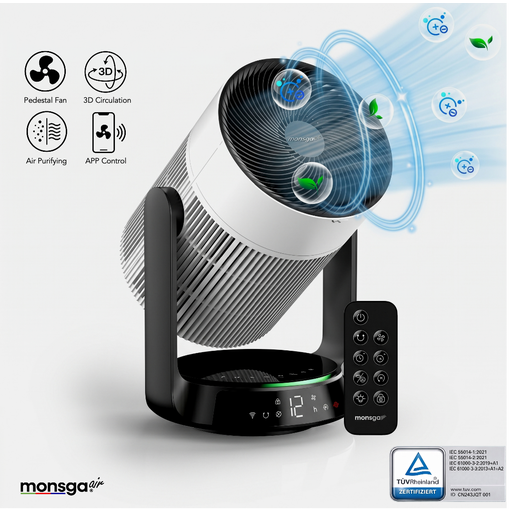
- Why We Chose It: This model combines two devices in one: a powerful air circulator and an air purifier. Where a normal fan blows dust and pollen around the room, this device filters the air. According to the manufacturer, it has a CADR (Clean Air Delivery Rate) of 280m³/h, making it effective against allergens and fine particulate matter (PM2.5). The 360° omnidirectional oscillation ensures that the purified air reaches every corner of the room.
- Pros:
- Combination of air circulation and purification.
- Very quiet in sleep mode (25 dB).
- Control via app, remote, and touch panel.
- Dynamic 3D airflow through a 360° base, 90° horizontal, and 120° vertical movement.
- Who It's For: Individuals with allergies (like hay fever) or anyone who values clean air, especially in enclosed, air-conditioned spaces. It is a year-round solution.
MonsgaAir AC300 Quiet Pedestal Fan
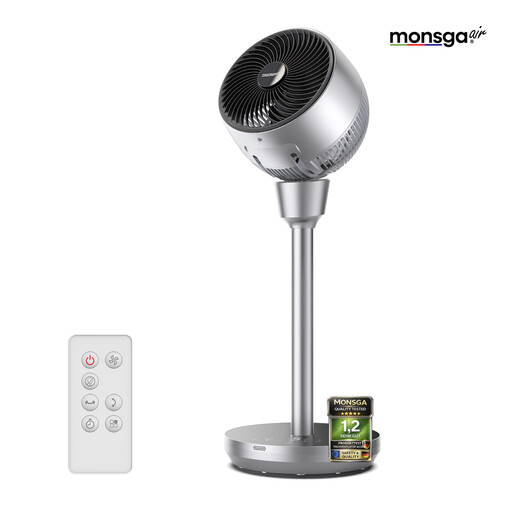
- Why We Chose It: This pedestal fan is designed for maximum airflow over a long distance. With a stated air volume of 1200 m³/h and a wind range of up to 25 metres, this model is aimed at large living rooms or open-plan offices. The combination of 120° horizontal and 90° vertical oscillation ensures wide and effective air circulation.
- Pros:
- Powerful airflow for large spaces.
- Quiet operation with a minimum of 25 dB.
- Omnidirectional oscillation for full room coverage.
- Stable design with a height of 76 cm.
- Who It's For: Users seeking a powerful yet quiet solution for a large living room, loft, or office. Ideal for boosting the effectiveness of an air conditioner or heater.
Monsga AC200 Turbo Table Fan
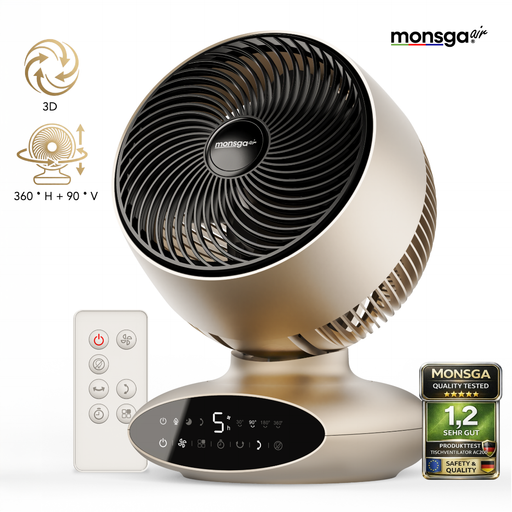
- Why We Chose It: This model is a powerful table fan that offers the performance of a larger model in a compact size. The combination of 360° and 90° dual oscillation is remarkable for a desk fan. The device is designed with user convenience in mind, featuring a detachable grille for easy cleaning and a child lock.
- Pros:
- Extensive oscillation options (30°, 90°, 180°, 360°).
- Quiet, with a noise level starting at 30 dB.
- Compact and portable, but with a long range (airflow ≥ 1200m³/h).
- Convenient features like a timer, remote control, and a dimmable display for nighttime use.
- Who It's For: Ideal for a bedroom, home office, or study where space is limited, but the need for effective and quiet air circulation is high.
Looking for a Different Solution?
An air circulator is focused on moving and evenly distributing the air within a room. However, if you are looking for direct cooling with a noticeably colder effect, another type of product might be a better fit. For situations where extra cooling through evaporation is desired, you can browse our selection of Misting Fans. These devices combine a fan with a fine water mist.
Frequently Asked Questions (FAQ)
1. What is the difference between a fan and an air circulator? A traditional fan creates a direct, narrow stream of air that you feel when you sit in front of it. An air circulator is designed to generate a vortex-like airflow that bounces off walls and ceilings, putting all the air in the room into motion. This creates a more even temperature and prevents stagnant, stuffy air.
2. Can an air circulator be used in the winter? Yes, in fact, it's a very useful device during winter. Warm air rises and collects near the ceiling. By placing an air circulator strategically, this warm air is pushed back down and distributed throughout the room. This heats the space more efficiently, potentially allowing you to lower your thermostat and save on energy costs.
3. How much noise does a quiet fan make? Noise level is measured in decibels (dB). A fan that produces less than 30 dB on its lowest setting is considered very quiet and is suitable for light sleepers. For comparison, 20 dB is similar to rustling leaves, while 30 dB is like a whisper. Always check the specifications for the minimum noise level.