
A Buyer's Guide to Air Purifiers in 2026
Choosing the right air purifier can be a challenge. The market is saturated with models that all promise clean air, but the complex specifications and technical jargon make it difficult to determine which device is truly right for your home. Making the wrong choice isn't just a waste of money; it means your problem—whether it's allergies, fine dust, or unpleasant odours—goes unsolved. This guide will help you make an informed decision based on facts and specifications.
What to Look for When Buying an Air Purifier?
To find the right air purifier, it's essential to understand a few key specifications. These objective metrics will help you compare models fairly.
- CADR (Clean Air Delivery Rate): This is arguably the most important specification. The CADR value, expressed in cubic meters per hour (m³/h), indicates how much clean air a device can deliver per hour. A higher CADR means the air purifier can clean a larger room more quickly. A good rule of thumb is to choose a model with a CADR that matches your room's size.
- Filter Type (HEPA Filter): The most effective air purifiers use a HEPA filter. A True HEPA filter is certified to capture 99.97% of airborne particles as small as 0.3 micrometers. This includes common allergens like pollen, dust mites, mould spores, and pet dander. It also effectively filters fine dust and smoke particles.
- Noise Level: If you're looking for an air purifier for the bedroom, the noise level is crucial. This is expressed in decibels (dB). A quiet air purifier will feature a dedicated sleep mode with a noise level below 30 dB, which is comparable to a whisper.
- Specific Needs: Do you suffer from a specific allergy? Or do you mainly want to eliminate smoke or cooking odours? Some models include an activated carbon filter in addition to a HEPA filter. This type of filter specialises in absorbing gases, chemicals, and odours.
Our Selection of Air Purifiers for 2026
Based on the criteria above, we have selected models with clear and verifiable specifications.
1. ELECCI True HEPA Filter Air Purifier
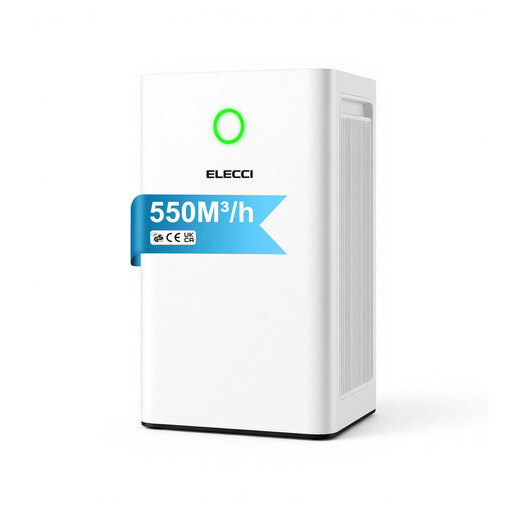
- Why We Chose It: This model stands out with its exceptionally high CADR of 550 m³/h, making it suitable for quickly and effectively purifying the air in very large spaces up to 120 m².
- Advantages:
- High Capacity: The powerful motor ensures rapid air circulation, ideal for open-plan living areas or offices.
- Multi-Filter System: In addition to its HEPA filter, the device is designed to tackle volatile organic compounds (VOCs), smoke, and odours.
- Quiet Sleep Mode: In sleep mode, the device produces only 24 dB, ensuring an undisturbed night's rest.
- Washable Pre-Filter: The pre-filter captures larger particles like dust and hair and is washable, which can extend the life of the main filter.
- Who It's For: Users with large living rooms, open kitchens, or studio apartments who need powerful and fast air purification. It's also a great option for environments with heavier pollution, such as households with smokers or multiple pets.
2. Blueair Blue Pure Mini Max Air Purifier
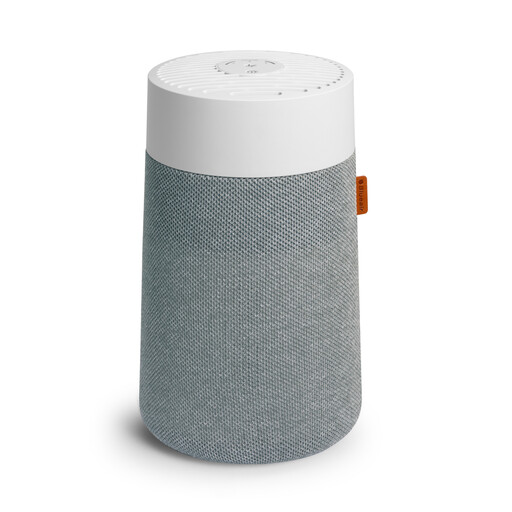
- Why We Chose It: The Blue Pure Mini Max combines a compact, portable design with Blueair's proprietary HEPASILENT filter technology. It's an efficient solution for smaller spaces.
- Advantages:
- Compact and Portable: Weighing just 2.5 kg, this model is easy to move from one room to another.
- Certified Performance: The CADR of 117 m³/h is independently verified by the Association of Home Appliance Manufacturers (AHAM).
- Efficient Filtration: According to the manufacturer, the technology removes 99.97% of particles down to 0.1 microns, including dust, pollen, and smoke.
- Simple Operation: The device features a minimalist interface with just two buttons for power and fan speed.
- Who It's For: Ideal for anyone seeking an effective air purifier for the bedroom, a child's room, or a small office (up to 20 m²). Its compact size also makes it a practical choice for dorm rooms or for travel.
3. Philips PureProtect Mini 900 Series Air Purifier
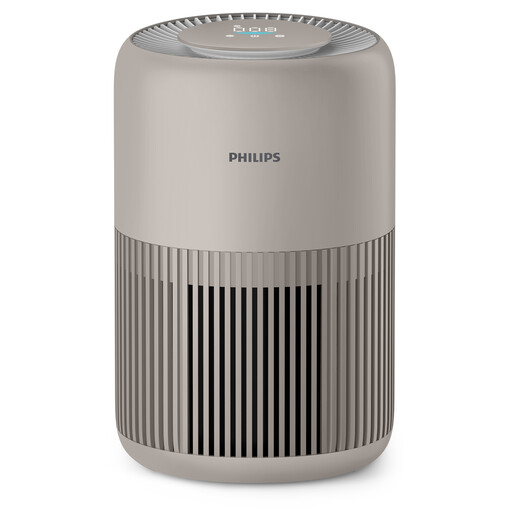
- Why We Chose It: This model from Philips offers a smart, automated approach to air purification. Its AeraSense technology continuously monitors air quality and adjusts its operation automatically.
- Advantages:
- Smart Sensor and Auto Mode: The AeraSense sensor detects fine particulate matter (PM2.5) and adjusts the fan speed accordingly. You don't have to manage it yourself.
- Ultra-Quiet Sleep Mode: With a noise level of just 20.5 dB(A), this is one of the quietest options for the bedroom.
- Effective Filtration: The 2-layer HEPA filter is designed by Philips to capture 99.97% of particles as small as 0.003 microns.
- Excellent Capacity for its Size: With a CADR of 250 m³/h, it can purify a 20 m² room in under 12 minutes and is suitable for spaces up to 65 m².
- Who It's For: Users looking for convenience and a "set-it-and-forget-it" solution. The automatic mode makes it ideal for people who don't want to constantly adjust settings but still want the assurance of clean air.
Didn't Find Your Match? Explore More Options
Every living situation is unique. If the models above don't perfectly match your needs—perhaps because you have a different budget, require specific dimensions, or are considering another filter technology—there is more to discover. A broader selection allows you to compare all specifications side-by-side.
Explore our full range of HEPA Filter Air Purifiers for more models and specifications.
Frequently Asked Questions about Air Purifiers
1. How often should I replace the HEPA filter in an air purifier? The lifespan of a HEPA filter depends on usage and the air quality in your environment. Most manufacturers recommend replacing the filter every 6 to 12 months. Many modern air purifiers have an indicator that lets you know when it's time for a replacement.
2. Does an air purifier really help with allergies like hay fever? Yes, an air purifier with a True HEPA filter can help reduce allergy symptoms. The device filters allergens such as pollen, dust mites, and pet dander from the air in a room. By lowering the concentration of these particles, it can decrease indoor exposure. While it is not a medical device, it can provide significant relief for many people.
3. What is the difference between an air purifier and a humidifier? An air purifier and a humidifier serve different functions. An air purifier filters particles (like dust, pollen, and smoke) from the air to improve its quality. A humidifier adds water vapour to the air to increase humidity, which can be particularly helpful against dry air in the winter. Some devices combine both functions, but they are fundamentally two different technologies.
Written by the Joybuy Product Recommendation Officer